


Make Your Brand Stand Out with Embossed Graphics
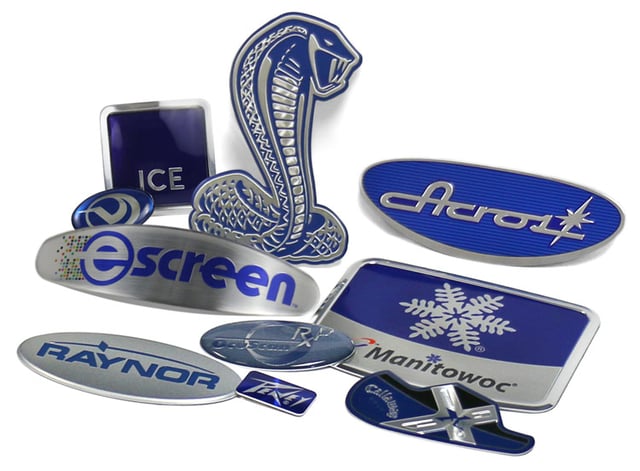
This article explores options in embossing aluminum to create dimensional nameplates for product identification. The embossing process uses a metal die to create a three-dimensional image in metal by squeezing the metal and raising the image. It is one of the final steps in manufacturing a nameplate or label. All brushing, spinning and printing is applied to the sheet of metal prior to the embossing operation. A topcoat protects the decoration during the tooling operations. Precise registration of printed decoration to embossed details is achieved through a combination of printers marks and guides.
Nameplate Embossing Options and Guidelines
2-D Emboss
- Logo - minimum stroke and space of .015" on .018" aluminum
- Border - minimum stroke of .015" with a minimum space of .005" to edge of part
- Background - edge of part must return to original height, minimum lip of .005" on .018" aluminum
This simple process is the most commonly used embossing option in nameplate design. The height of the emboss is dependent on the thickness of the metal substrate and the type of tool used. Typical embossed graphics range in height from .005" to .025".
3-D Emboss
- Multi-level - raises graphics into multiple flat planes
- Sculptural - raises logos into multi-dimensional surfaces
- Beveled - creates multiple facets
A 3-D emboss opens up a world of possibilities in creating intricate detail and depth. Combine this process with the wide variety of options in decorating aluminum and to create an attention-getting look to represent your brand.
Deboss
Debossing uses a metal die to create a recessed image in aluminum. Options include recessing graphics or raising the background area leaving the graphics at original height giving the effect of recessed graphics. Debossing is basically the embossing process used to create recessed graphics. Special considerations need to be taken into account when choosing an attachment method for debossed nameplates to assure good adhesion.
Coin
Coining uses a metal die to disrupt the surface of the metal. Since the bottom die is flat, the depth is limited in the coining process. Therefore, it is best suited to fine graphics with a minimum stroke of .010". The wider the graphics become, the more difficult it is to perceive the relief.
Patterns
Embossing and coining aren't limited to only graphics and borders. They also are also used to create hammered effects and crisply detailed geometric textures and patterns.
Want to explore more tooling options? Check out the Aluminum Tooling Guide.